
Physiotherapy after total knee replacement · home visits across Hong Kong
Physiotherapy after knee replacement,
the first 6 weeks and walking ability later
The operation for total knee replacement (TKR) is only half of the treatment. Rehabilitation in the first 6 weeks after surgery decides final walking ability and flexion angle. Our registered physiotherapists visit the home to guide the patient safely to the flexion and extension targets and to restart the quadriceps, and we set out what the research really shows about CPM machines and prehabilitation.
- Registered physiotherapists in Hong Kong
- Home visits across Hong Kong
- 1 hour $1,000 · 1.5 hours $1,300
- Making the most of the 6-week key period
Looking at the question again
Common misunderstandings after knee replacement
Recovery after knee replacement does not come from using more machines, and it does not come from rest alone. Passive machines and muscle training before surgery are often given more credit than they deserve, and the patient's own active training is the key to recovery. Knowing which methods have research behind them, and which only give reassurance, avoids wasted effort.
- The longer I rest in bed, the faster I recoverLong bed rest after surgery actually slows the return of muscle strength and mobility.
- Using a CPM machine will certainly helpThe benefit of passive machines is often overestimated, and the patient's own active training is the key.
- Exercising the muscles before surgery means a quicker recovery afterwardsThere is currently no consistent research evidence that rehabilitation training before surgery improves mobility after surgery.
- I must go to a clinic for treatment every day for it to workRehabilitation at home under professional guidance gives results as good as going to a clinic, and is more convenient.
- Early movement helps recoveryAccording to the enhanced recovery after surgery (ERAS) programme, getting out of bed early is a core way to speed recovery after joint replacement.
- CPM gives only about 2° moreA Cochrane review found that CPM machines give no clear clinical benefit, which is not enough to support routine use.
- Prehab only shortens the hospital stayResearch has not confirmed that training before surgery gives a definite benefit for pain, walking or mobility after surgery.
- Supervision is what makes it workThe CORKA trial showed that rehabilitation at home and at an outpatient clinic give similar results, and that home rehabilitation costs less.
These conclusions mostly come from systematic reviews and randomised controlled trials. The functional benefit of physiotherapy after surgery is short term (3–4 months), and the evidence for a longer-term additional benefit is limited. CPM and prehabilitation being overrated does not mean they are completely useless. They should not replace active ROM and strength training. Specific prescriptions always follow the instructions of the orthopaedic doctor and the physiotherapist.
Training methods aimed at the underlying problems
Main areas of intervention in rehabilitation after knee replacement
The four interventions each address a main factor in recovery after knee replacement: the key period of the first 6 weeks, early weight bearing, restarting the quadriceps, and guided training at home.
The first 6 weeks: range of motion comes first
The operation is only half of the treatment. The first 6 weeks after surgery are the key window for regaining joint range of motion and quadriceps strength, and after that the same amount of training brings less benefit. We visit the home to take over from the acute phase and teach the patient to reach the targets for flexion and full extension safely.
Getting out of bed and bearing weight early, not long bed rest
Current clinical guidance does not recommend long bed rest after surgery. Getting out of bed early and practising weight bearing are an important part of the enhanced recovery after surgery (ERAS) programme, and help circulation and lower the risk of blood clots. As long as the wound and pain allow, we teach the patient to stand and walk again step by step.
Restarting the front thigh muscle within 48 hours
After knee replacement, the front thigh muscle (quadriceps) often finds it hard to produce force by itself, and this is one of the main difficulties of rehabilitation. Randomised controlled trials (RCTs) show that using neuromuscular electrical stimulation (NMES) early, together with active exercise, clearly improves muscle strength and mobility, and part of the effect can last up to a year.
Guided home training with results similar to outpatient care
Patients do not have to travel to a clinic every day on crutches. Having a professional present to guide the exercise matters more than where it is done. Rehabilitation at home under a physiotherapist gives results similar to outpatient care, is more convenient and costs less.
Why therapy at home
Home training settings after knee replacement
Rehabilitation after knee replacement needs to be guided in the real living environment. Bending, straightening, exercising the front thigh muscle and using stairs are all demonstrated with the bed, chairs and stairs at home, so that the patient can really do them in daily life. Going out is not easy in the early period after surgery, and home physiotherapy solves this problem.
Training map of the home HOME SETTINGS
Controlling swelling first makes training easier
Cold compression to reduce swelling after knee replacement
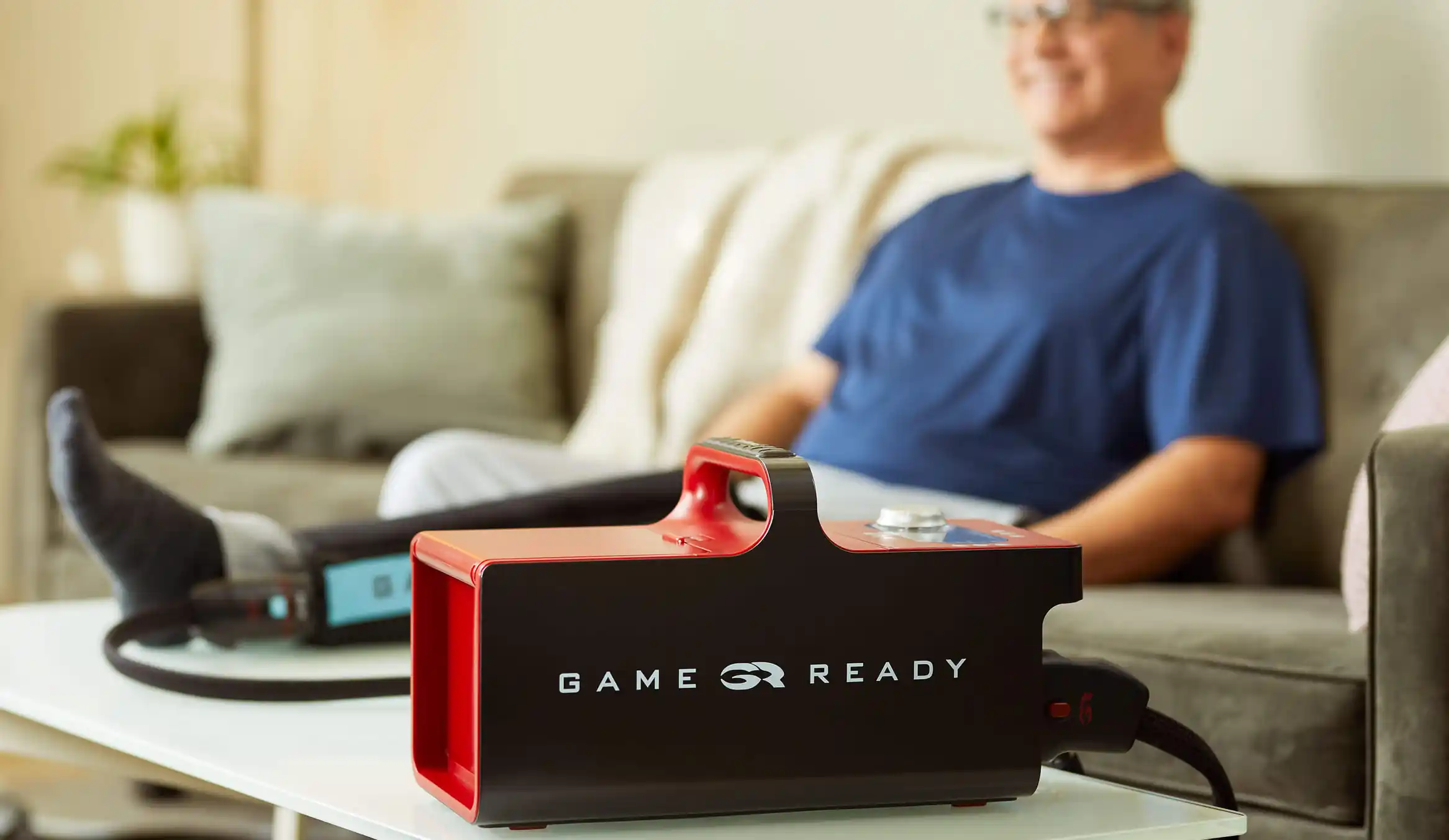
When the knee is swollen, it is hard to increase the bending angle and hard for the front thigh muscle to produce force. Ordinary ice alone often does little to reduce swelling. Cold and intermittent compression are two different treatments, and a clinical-grade cold compression machine does both at once. When swelling is under control, the active training above can go ahead more smoothly.
Game Ready (manufacturer)GRPro 2.1Suitable for: after total or partial knee replacement
Why cold and compression are applied together COLD + COMPRESSION
- Ice packs fall shortAn ice pack warms up within a short time and gives no pressure, so it does little to reduce swelling after surgery
- Cold and compression togetherCirculating ice water keeps the temperature low while the sleeve applies intermittent pneumatic compression, so the two treatments are combined
- Swelling under controlWhen knee swelling goes down, the bending angle can be regained and the quadriceps can produce force
- Steady standing and easy walkingEnough active training every day is the real source of walking ability
Three differences from ordinary ice SPEC
RCT · 280 people, 11 centresSu 2012 (the study device was Game Ready): from discharge to week 2, less opioid painkiller use and higher patient satisfaction. The evidenced benefit is concentrated in the first weeks after surgery
RCTQuesnot 2024 (cold compression vs cold alone, after knee replacement): at day 21, less joint effusion, less pain on activity and a longer distance in the walking test
As mentioned above, passive machines such as CPM are used in place of the patient moving, and the research does not support that approach. A cold compression machine is not meant to replace active training. It reduces swelling first, so that the patient can practise bending, straightening and muscle exercises every day. In other words, the machine supports the training. When to use it, and for how long each time, is guided by the physiotherapist according to the condition of the skin and wound.
For the rental process, sleeves for other body areas and precautions, see the details of GameReady clinical-grade cold compression machine rental.
Clinical evidence
The evidence for training after knee replacement
The three research findings below answer the three questions patients ask most: when training starts to work, how long the effect lasts, and whether training at home is workable. All three answers show that patients need guided, active training.
Randomised controlled trial data EVIDENCE
These improvements are small but statistically significant, and concentrated in the first few months after surgery, and there is not enough evidence for a longer-term additional effect. The figures for passive machines (CPM gives only about 2° more flexion) were explained in the section on common misunderstandings above. We therefore describe the current research evidence as it stands, make a training plan for each individual, and follow the instructions of the orthopaedic team.
Have you just had a knee replacement and are not sure which movements are safe and which need care? Tell us about the situation and a physiotherapist will answer your questions.
WhatsApp for a free enquiry and home assessmentFrom the basics to the detail
Rehabilitation after knee replacement: further reading
To learn about the recovery timeline, knee flexion targets, quadriceps training, what CPM machines really do, or when it is possible to drive, kneel and go back to work, see the related physiotherapy topics below.
Related physiotherapy topics 03
Physiotherapy after surgeryCommon complications after surgery and the benefits of early mobilisationPhysiotherapy after total hip replacementWalking training and ways to prevent dislocation after hip replacementPhysiotherapy after spine surgeryRehabilitation after disc, laminectomy and spinal fusion surgeryFAQ · rehabilitation after knee replacement
Rehabilitation after knee replacement: frequently asked questions
How long does physiotherapy take to work after knee replacement?
The key period for recovery after surgery is the first 6 weeks, when training of knee range of motion (ROM) and the quadriceps matters most. A systematic review (Artz et al., 2015; 18 randomised controlled trials, 1,739 patients) showed that physiotherapy exercise brings a small but clear improvement in function and pain at 3 to 4 months after surgery (standardised mean differences of about −0.37 and −0.45), and most patients return to their pre-operative activity level at about 6 months. The evidence for further benefit beyond that (after a year) is limited, so continuing, professionally guided training matters more than stopping after a few months.
The hospital told me to use a CPM (continuous passive motion) machine. Is it really needed?
The evidence is limited. A Cochrane systematic review (Harvey et al., 2014) found that CPM machines increased active knee flexion by only about 2 degrees (95% confidence interval 0 to 5 degrees), with no clinically meaningful improvement in pain, function or quality of life, which is not enough to support routine use. Active range of motion and strength training (such as heel slides in bed and quadriceps contractions) are generally more important than a passive machine. Whether to use CPM should be discussed with the orthopaedic doctor and the physiotherapist.
Is physiotherapy before the operation (prehabilitation) useful?
The evidence for prehabilitation has two parts. It has real benefits: several meta-analyses show that it can shorten the hospital stay and improve knee flexion and mobility before surgery (Su et al., 2022), and patients with weaker fitness benefit most. This kind of preparation can also be done by a physiotherapist at home. For pain after surgery, the 6-minute walk and overall functional recovery, however, the research has no consistent evidence, and most studies have a high risk of bias (Adebero et al., 2024; Peer et al., 2017). The order of priority is therefore clear: prehabilitation is a bonus, and training in the first 6 weeks after surgery is what mainly decides final walking ability. If the budget is limited, it should be kept for after the operation.
When can I walk alone and use stairs after knee replacement?
Under an enhanced recovery (ERAS) pathway, many patients can get out of bed and walk with a walking frame on the first day after surgery (Soffin and YaDeau, 2016). Using stairs generally needs knee flexion of about 90 to 100 degrees, and most patients reach a satisfactory range at about 6 weeks after surgery, after which they can use stairs independently more safely. Actual progress varies from person to person and should advance step by step according to the physiotherapist's assessment.
Is home-visit physiotherapy less effective than going to a clinic?
No. The CORKA randomised controlled trial in knee replacement patients (Barker et al., 2020) found no significant difference between home-based rehabilitation and conventional outpatient physiotherapy in functional outcomes, and the home-based option cost less (about £66 less direct cost per person). Another meta-analysis of 11 randomised controlled trials (Florez-García et al., 2017) also concluded that short-term function and knee range of motion were comparable. For patients with limited mobility after surgery, professionally guided home-visit physiotherapy is a choice that offers both effectiveness and convenience.
Is it normal for the quadriceps (front thigh muscle) to be especially weak after knee replacement? How should it be trained?
Yes, it is normal. Research (Bade et al., 2010) shows that all measures of knee performance, including strength, fall clearly in the first month after surgery, and this is the main challenge of rehabilitation. Neuromuscular electrical stimulation (NMES) started early (within 48 hours of surgery) together with active exercise has been shown in a randomised controlled trial (Stevens-Lapsley et al., 2012) to improve quadriceps strength, functional performance and knee extension range clearly, and some of the benefit was kept at one year. At home, training can start with isometric quadriceps contractions and straight leg raises, and add sit-to-stand practice and resistance band work step by step.
If you have questions about life after a knee replacement operation, you are welcome to message us at any time.
WhatsApp for a free enquiry and home assessment1 hour $1,000 · 1.5 hours $1,300 · no minimum spend · Prices for all services
Disclaimer: This article is general health information and is not professional medical advice. If you have any health concerns, please consult a qualified healthcare professional.
References
- Artz, N., Elvers, K. T., Lowe, C. M., Sackley, C., Jepson, P., & Beswick, A. D. (2015). Effectiveness of physiotherapy exercise following total knee replacement: systematic review and meta-analysis. BMC Musculoskeletal Disorders, 16, 15. https://doi.org/10.1186/s12891-015-0469-6
- Bade, M. J., Kohrt, W. M., & Stevens-Lapsley, J. E. (2010). Outcomes before and after total knee arthroplasty compared to healthy adults. Journal of Orthopaedic & Sports Physical Therapy, 40(9), 559–567. https://doi.org/10.2519/jospt.2010.3317
- Pozzi, F., Snyder-Mackler, L., & Zeni, J. (2013). Physical exercise after knee arthroplasty: a systematic review of controlled trials. European Journal of Physical and Rehabilitation Medicine, 49(6), 877–892. https://pubmed.ncbi.nlm.nih.gov/24172642/
- Mistry, J. B., Elmallah, R. D., Bhave, A., Chughtai, M., Cherian, J. J., McGinn, T., Harwin, S. F., & Mont, M. A. (2016). Rehabilitative guidelines after total knee arthroplasty: a review. The Journal of Knee Surgery, 29(3), 201–217. https://doi.org/10.1055/s-0036-1579670
- Harvey, L. A., Brosseau, L., & Herbert, R. D. (2014). Continuous passive motion following total knee arthroplasty in people with arthritis. Cochrane Database of Systematic Reviews, (2), CD004260. https://doi.org/10.1002/14651858.CD004260.pub3
- Su, W., Zhou, Y., Qiu, H., & Wu, H. (2022). The effects of preoperative rehabilitation on pain and functional outcome after total knee arthroplasty: a meta-analysis of randomized controlled trials. Journal of Orthopaedic Surgery and Research, 17(1), 175. https://doi.org/10.1186/s13018-022-03066-9
- Adebero, T., Omana, H., Somerville, L., Lanting, B., & Hunter, S. W. (2024). Effectiveness of prehabilitation on outcomes following total knee and hip arthroplasty for osteoarthritis: a systematic review and meta-analysis of randomized controlled trials. Disability and Rehabilitation, 46(24), 5771–5790. https://doi.org/10.1080/09638288.2024.2313128
- Peer, M. A., Rush, R., Gallacher, P. D., & Gleeson, N. (2017). Pre-surgery exercise and post-operative physical function of people undergoing knee replacement surgery: a systematic review and meta-analysis of randomized controlled trials. Journal of Rehabilitation Medicine, 49(4), 304–315. https://doi.org/10.2340/16501977-2210
- Stevens-Lapsley, J. E., Balter, J. E., Wolfe, P., Eckhoff, D. G., & Kohrt, W. M. (2012). Early neuromuscular electrical stimulation to improve quadriceps muscle strength after total knee arthroplasty: a randomized controlled trial. Physical Therapy, 92(2), 210–226. https://doi.org/10.2522/ptj.20110124
- Soffin, E. M., & YaDeau, J. T. (2016). Enhanced recovery after surgery for primary hip and knee arthroplasty: a review of the evidence. British Journal of Anaesthesia, 117(suppl 3), iii62–iii72. https://doi.org/10.1093/bja/aew362
- Barker, K. L., Room, J., Knight, R., Dutton, S. J., Toye, F., Leal, J., Kent, S., Kenealy, N., Schussel, M. M., Collins, G., Beard, D. J., Price, A., Underwood, M., Drummond, A., Cook, E., & Lamb, S. E. (2020). Outpatient physiotherapy versus home-based rehabilitation for patients at risk of poor outcomes after knee arthroplasty: CORKA RCT. Health Technology Assessment, 24(65), 1–116. https://doi.org/10.3310/hta24650
- Florez-García, M., García-Pérez, F., Curbelo, R., Pérez-Porta, I., Nishishinya, B., Rosario Lozano, M. P., & Carmona, L. (2017). Efficacy and safety of home-based exercises versus individualized supervised outpatient physical therapy programs after total knee arthroplasty: a systematic review and meta-analysis. Knee Surgery, Sports Traumatology, Arthroscopy, 25(11), 3340–3353. https://doi.org/10.1007/s00167-016-4231-x
- Quesnot, A., Mouchel, S., Salah, S. B., Baranes, I., Martinez, L., & Billuart, F. (2024). Randomized controlled trial of compressive cryotherapy versus standard cryotherapy after total knee arthroplasty: pain, swelling, range of motion and functional recovery. BMC Musculoskeletal Disorders, 25(1), 182. https://pubmed.ncbi.nlm.nih.gov/38419032/
- Su, E. P., et al. (2012). A prospective, multi-center, randomised trial to evaluate the efficacy of a cryopneumatic device on total knee arthroplasty recovery. The Journal of Bone and Joint Surgery (Br). https://pubmed.ncbi.nlm.nih.gov/23118406/