After a stroke, doing exercise and doing it correctly are often two different things. Many families assume that if someone helps the older person move the limbs and walk a few more steps each day, function will come back by itself. Clinically, though, many patients make no progress however much time they spend practising. The cause is usually not too little effort but that the dose, accuracy and individualisation of the training are not what they should be.
This is the biggest difference between one-on-one treatment and ordinary group or generic exercise. From the physiotherapist’s professional point of view, the sections below first set out the science of how the brain recovers, and then explain why targeted one-on-one training so often does much more for stroke rehabilitation.
The key to stroke rehabilitation is the neuroplasticity of the brain. The patient needs enough repetitions that are accurate and targeted before undamaged areas of the brain can relearn the control of movement that was lost. The role of one-on-one training is to achieve all three at once.
The science of stroke rehabilitation
Although a stroke damages some brain cells, the brain is not unable to change. With the right stimulation, the neural networks next to the damaged area can reorganise and take over the lost function, a process called neuroplasticity. Research has set out four principles that drive neuroplasticity: use it or lose it, repetition, intensity and specificity. In short, practice must be frequent enough, repeated enough, have a suitable level of difficulty and stay close to the target movement.
Think of the brain as a stretch of grass. A path that is walked often becomes clear, and a path that is neglected is slowly covered with weeds. After a stroke, the neurons around the damaged area of the brain must rely on one correct practice after another to build again the pathways that control body movement. There are two conditions that cannot be left out. The first is enough repetitions, so that the neural pathways take shape. The second is enough accuracy, to make sure the right route is being laid down and that wrong compensatory movements are not being drilled in deeper. This also shows why simply moving more is not enough. Once the direction is wrong, the more the effort, the more a path that leads nowhere is reinforced.
Progress in rehabilitation often stalls because the amount of training is too small. One study observed that in a usual treatment session, stroke patients actually completed only about 32 effective limb movements. In animal experiments, however, hundreds of repetitions are needed to trigger neuroplasticity. If the number of repetitions is not enough, even a patient who works very hard will find it hard to achieve a real change in the brain.
Another trap that is easier to overlook is called learned non-use. After a stroke, the affected side is weak, so the patient naturally turns to the unaffected side for daily tasks. The unaffected side gets more and more skilled, while the affected side is increasingly neglected, and the brain’s control of the affected side falls further, setting up a vicious circle. This is especially marked in recovery of the arm and hand after stroke. To break out of it, someone must actively guide the patient to use the affected side again, within a safe and correct range, and this is exactly what an ordinary group class or exercise alone finds hardest to cover. In other words, what really blocks stroke rehabilitation is often not weakness itself but the secondary decline that comes from wrong methods and too little practice.
How one-on-one training differs from generic or group exercise
Both are exercise, but the quality of nerve stimulation the two training modes bring is very different:
- A uniform pace, and the difficulty may not suit the individual
- Easy to get through with compensatory movements
- Intensity and number of repetitions are generally not enough
- Errors are hard to spot and correct at once
- Higher safety risks such as falls
- Difficulty set to the individual’s ability
- Movements corrected at once, so compensation does not become a habit
- Effective repetitions brought up to the target level
- Supervised throughout, with load increased step by step in safety
- Closely tied to personal goals and real-life situations
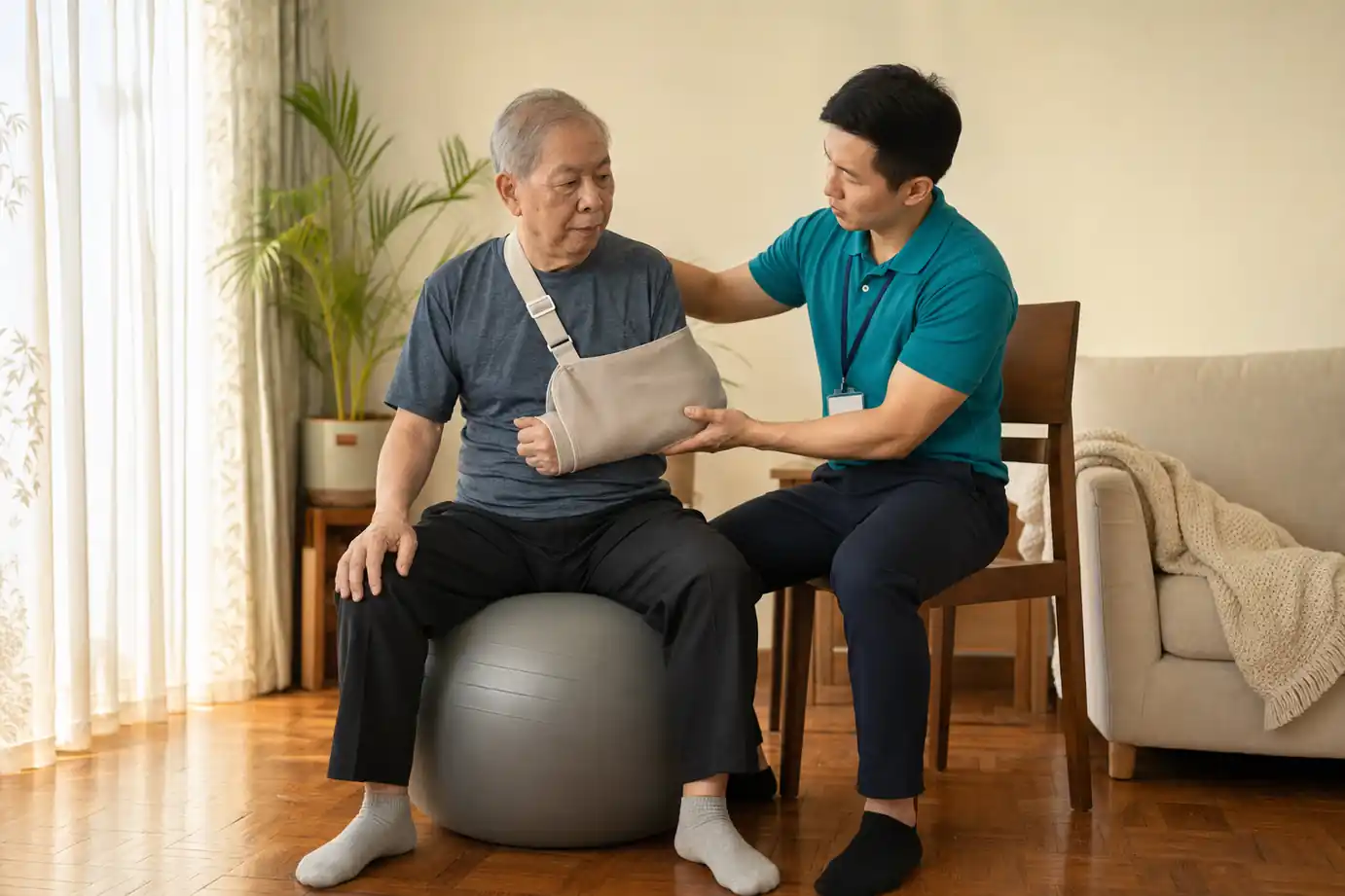
The core difference between the two is not whether the patient moves but the quality of the training stimulus. Following videos online or exercising in a big class means the pace and difficulty are designed for the average ability of an ordinary person. Yet every stroke patient differs in strength, muscle tone, balance and cognition, and the same set of movements may be too easy for one patient and too hard for another, so the result is either wrong compensation or giving up halfway. By contrast, a therapist working one-on-one gives feedback and fine-tunes the movement at once. As soon as the patient uses the wrong effort or shrugs a shoulder to borrow force, the therapist can correct it immediately, making sure that every repetition turns into real rehabilitation benefit.
Five features of one-on-one physiotherapy
One-on-one training works better not simply because there is one more person alongside, but because the whole rehabilitation process has five layers of professional oversight that a group class can hardly match:
Rehabilitation often stalls not because the patient lacks perseverance but because the posture is wrong or the number of repetitions is too small. One-on-one treatment can deal with both problems at once, making sure that every movement is done correctly and that enough practice is done for the brain to learn again.
How a one-on-one stroke rehabilitation programme runs
A professional one-on-one programme is by no means a casual routine of training the arm one day and the leg the next. It is a rigorous process based on clinical assessment, with progress that can be measured and continually adjusted. From the first assessment to the home training prescription, each step links to the next:
- 1Full assessmentThe therapist first learns the medical history, current muscle ability, balance and safety risks, and finds the problems that most affect daily life.
- 2Setting individual goalsThe therapist talks with the patient and family to set specific short-term and long-term goals together, for example what is to be achieved within three months.
- 3Task-based targeted trainingTraining is built around the real movements of daily life, making sure the posture is accurate and the number of repetitions is enough.
- 4Home exercise prescriptionThe therapist designs a list of exercises that can be practised at home and teaches the caregiver in person how to support and assist correctly.
- 5Regular reassessment and adjustmentThe therapist updates the goals and training intensity regularly according to recovery progress, and adjusts the plan in good time.
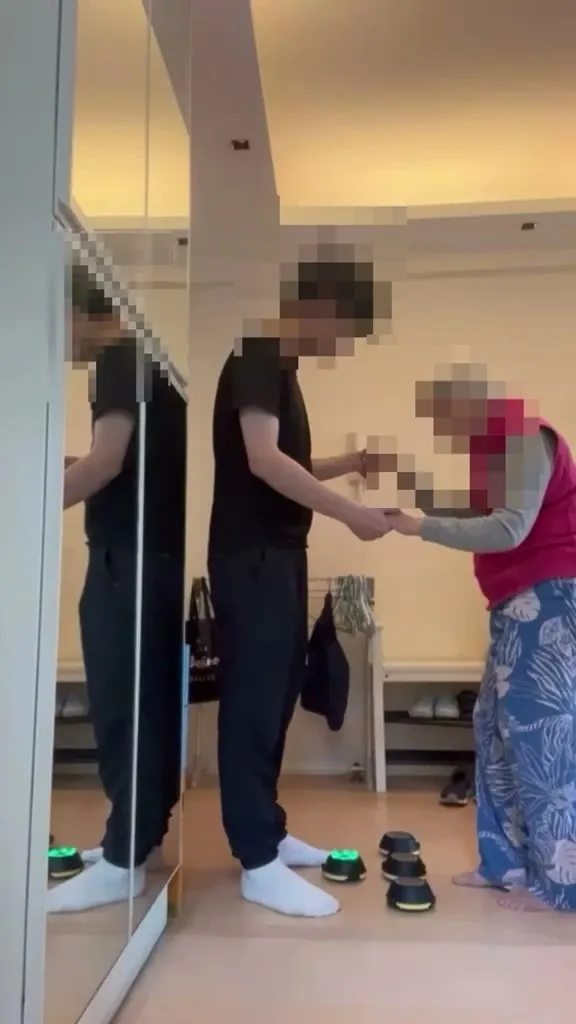
Among these steps, the home exercise prescription is often what decides success or failure in rehabilitation. The hours a physiotherapist can visit each week are always limited, and building up enough training dose depends entirely on family members or caregivers helping with practice during the rest of the week. A good exercise prescription therefore goes beyond listing which movements to do. It teaches the caregiver clearly how to support the patient, where to hold, how many repetitions to do and when it is a must to stop, and may even include a correct demonstration filmed on a phone, to make sure that daily practice between sessions is just as accurate.
One-on-one training at home
Absolutely, and it often suits actual needs better. One-on-one treatment at home takes place in the familiar home environment, and the content of training maps directly onto everyday situations, which helps the benefit of practice to turn into real self-care ability. The key is that a registered physiotherapist sets the prescription and strictly supervises the number of repetitions and the quality of movement. The right ways and the common mistakes in home stroke rehabilitation are listed below:
- The physiotherapist sets an exercise programme according to the patient’s condition and adjusts it regularly
- Record the number of repetitions completed each day, to make sure the training dose is enough
- Family members or caregivers learn together the correct ways to help and protect
- Just stretching or moving the limbs casually, without a target and without a fixed number of repetitions
- Letting the patient borrow force with the good side of the body, so that the habit of doing the movement wrongly becomes fixed
- Not practising at all for fear of falling, and missing the critical window for rehabilitation
Home training has one more advantage that is hard to match: it is closely tied to real-life situations. The patient can practise sitting up from the edge of the bed directly in the bedroom, turning to sit down in the bathroom that he or she usually uses, and standing and reaching for things at the family’s own dining table. This approach of practising where one lives is more likely to turn into independent self-care in daily life than abstract training in an unfamiliar clinic. With regular follow-up and reassessment, one-on-one treatment at home is often a practical choice that balances rehabilitation results with quality of life.
Frequently asked questions
Stroke rehabilitation is like an endurance race against time. Making use of the first three to six months after the stroke, using the right method and practising enough repetitions, can often rewrite the course of recovery. If the family is not sure whether the older person’s usual exercise posture is correct and the amount of practice enough, arranging a professional physiotherapist to visit and assess is the safest way to take the first right step in rehabilitation.
Would you like to arrange professional stroke rehabilitation training for yourself or a family member? Our registered physiotherapists can visit for a one-on-one assessment, design an exercise prescription for you and follow up throughout.
Ask about home stroke rehabilitation