
After going home from knee replacement surgery, family members look at the swollen, shiny knee and calf and the question they ask most is how long it will take for the swelling to go down. There is no single standard answer, but there is a rough timeline to follow, and a series of markers that help to tell "when it is normal and when to be on guard".
A direct answer: the knee is most swollen in the first 6 to 8 days after knee replacement (the swelling peak), and most of the obvious swelling takes a few weeks to settle. After that, mild swelling is normal and can last from a month and a half to 6 months before it goes completely. If one calf suddenly becomes hot and swollen with pain, if there is breathlessness, or if the wound discharges pus with fever, these are danger signs and a doctor must be seen at once. Note that the timing of "a peak at 6 to 8 days" comes mainly from clinical education consensus and studies of early peak swelling (Loyd 2019). It is not a hard percentage from peer-reviewed research, and individual patients can differ greatly.
The normal timeline for swelling to go down after knee replacement
Swelling after surgery can be divided into three stages. From the day of surgery to the first 6 to 8 days is the peak period of worst swelling, because after the tissue is injured the body sends a lot of fluid to repair it, and the operated leg naturally swells to its maximum. After the peak, the following weeks show the clearest settling, with the knee circumference getting smaller week by week. The last "long tail" stage is often the one that worries patients most: whenever there is more walking, longer standing or stuffy weather, mild swelling easily rebounds, coming and going for a month and a half or even half a year before it disappears completely. This is not a complication. It is simply that joint effusion and calf oedema go down slowly in themselves. To see which stage of the whole recovery process the patient is in now, and the care focus at each stage, see the parent page, the overview of swelling, pain and the wound after knee replacement.
Specific figures such as "the knee swells by 35% in the first 6 to 8 days after surgery" should not be taken too literally. Much health information in circulation says that the knee swells by more than 30% after surgery. The general direction is right, in that the first few days are indeed the most swollen, but the specific percentage is a common promotional claim and not strictly reviewed research data. To judge whether the progress of swelling is normal, watching the overall change (for example whether the swelling is slowly going down and whether it goes down after the leg is raised) is far more practical than fixing on one percentage.
Telling joint effusion apart from calf oedema
Swelling after surgery has at least two sources, and they go down at different speeds, which explains why the operated leg may still be swollen more than a month and a half after surgery. Once the two are told apart, an ankle that is puffy is not mistaken straight away for a problem with the artificial joint.
Knee joint effusion
- Fluid collects inside the joint space, making the knee swollen and tight and limiting the range when it bends
- Mostly related to the reaction of the tissue to the surgery, and it goes down more slowly
- If the person has walked more or put more weight on the leg that day, the swelling easily rebounds
Pitting oedema of the calf
- Fluid collects in the soft tissue of the calf and ankle, and pressing with a finger leaves a dent
- Mainly related to gravity, sitting for too long with the legs hanging down, and slower return of blood
- Usually most obvious in the evening, after sitting for a long time, or after going up and down stairs
The two together cause the pattern of "sometimes better, sometimes swollen" in the first few months after surgery. It is worth noting that this is far from only a matter of appearance. Swelling actually slows recovery of knee bending and walking, and the next section explains why.
How swelling affects knee bending and muscle force
Swelling is uncomfortable, and also sets off a chain reaction that slows recovery of bodily function. Research found that it is the peak swelling early after surgery (and not the cumulative total swelling) that is the key. Peak swelling explains 16% of the variation in the time on the Timed Up and Go test (TUG) at 2 weeks after surgery, while cumulative swelling had no significant predictive effect (Loyd 2019). In other words, controlling the swelling peak in the first two weeks well directly influences how quickly the patient regains walking ability.
The mechanism above shows why "how many degrees of bending by when" happens together with the settling of swelling. For the targets and timetable of bending angle after surgery, see bending angle goals after knee replacement. If the swelling period has passed and swelling has clearly settled but pain continues for months, see what to do about pain months after knee replacement.
The research evidence for each way of reducing swelling
There is no single miracle cure for swelling. The research evidence for different care methods varies greatly in strength, and they must be combined to work. The largest systematic review on reducing swelling after knee replacement, in 2025, pooled 140 studies and pointed out that using ice in the first 2 weeks after surgery, and keeping the knee in a bent position after surgery (about 30 to 90 degrees in the first 72 hours), were both consistently linked to less swelling (McGarry 2025). The review also looked at technical factors in the operation itself, but that part is decided by the operating surgeon and the orthopaedic team and is outside rehabilitation. Below are the care methods that can be done at home, with the strength of the evidence for each:
- Compression together with ice (more consistent evidence)A randomised controlled trial compared "compression ice" with ordinary ice. The group with compression ice had clearly less joint effusion at day 21, reached 90 degrees of knee bending sooner, and did better on the 6-minute walk test (Quesnot 2024). This shows that ice used together with compression works clearly better than ice alone.
- Ice (weak evidence when used alone)A review pooling 8 randomised controlled trials found that in 6 of those studies, ice alone did not clearly help to reduce swelling (Lee 2023). Ice can be used to ease pain and discomfort, but swelling should not be expected to go down with ice alone.
- Ankle pump exercise (reasonable mechanism, recommended by consensus)Repeatedly pulling the toes up and pushing them down makes the calf muscles work like a pump, helping blood to return to the heart and easing calf oedema. The risk is very low, and it is a basic exercise generally recommended by healthcare staff, which should be done at set times.
- Elevating the leg (reasonable mechanism, recommended by consensus)Raising the operated leg uses gravity to help fluid flow back to the upper body, and directly improves pitting oedema in the calf. This is also a basic, free approach, best done together with ice and compression.
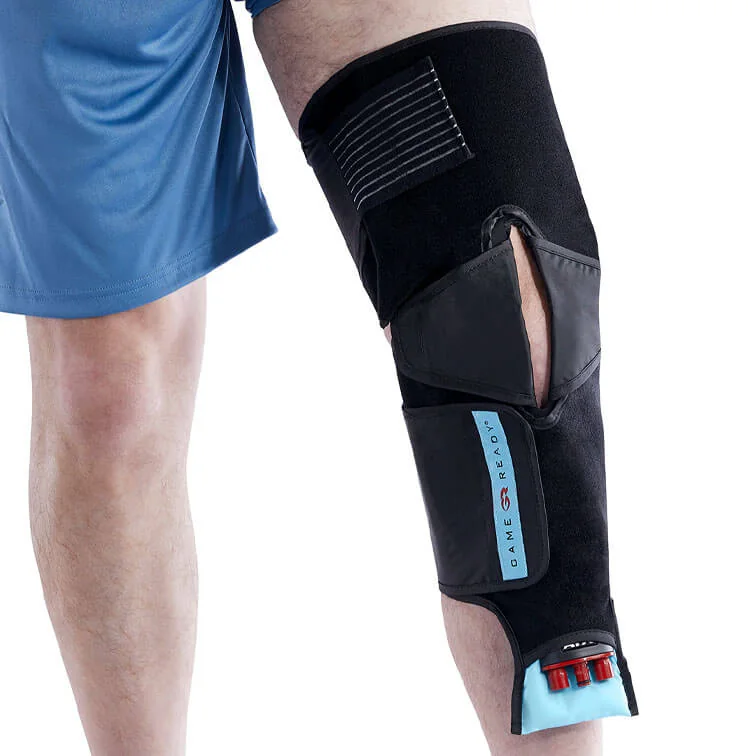
"High-tech equipment" does not necessarily beat a basic care combination. A multicentre randomised controlled trial across 11 international centres with 280 people found that, comparing a cryopneumatic device with ice plus static compression, there was no significant difference between the two groups in knee circumference (that is, the degree of swelling) at 2 and 6 weeks after surgery (Su 2012). This shows that doing the basic combination fully is the key. The practical advantage of a pneumatic device is that it circulates automatically at a steady temperature, saving the trouble of changing ice bags often, and in that trial patients used less pain medicine from discharge to 2 weeks after surgery. If there is an interest in trying one, renting one (GameReady cold compression machine rental)makes far more sense than spending several thousand US dollars on a new machine. For reducing swelling, however, it should not be expected to beat a basic combination done fully, and before renting, a doctor's referral letter must be obtained stating that the patient is suitable for cold and compression therapy.
The right way to elevate the leg and apply ice
Once it is clear that the methods need to be combined, there must be specific standards for carrying them out. The home care routine below can be repeated every day and strings together the evidence-supported methods above:
- 1Raise the leg so the ankle is above the heartLie flat first and use pillows to raise the whole lower leg, so that the ankle is higher than the heart. Remember to raise the whole lower leg and not only to put a pillow under the knee. Putting a pillow only under the knee bends the joint slightly, and gets in the way of practising straightening the knee.
- 2Ice for 15 to 20 minutesWrap the ice bag in a towel to avoid frostbite of the skin, and apply it for about 15 to 20 minutes each time, several times during the day. Extra towel padding is needed where the skin near the wound is numb, because sensation is dull there and a cold injury would hardly be noticed.
- 3Gentle compression at the same timePut on a medical-grade compression stocking or elastic bandage prescribed by the doctor, and combine compression with ice, which gives a better effect on swelling than ice alone (Quesnot 2024). Compression stockings, however, must be worn for enough hours each day to work.
- 4Ankle pumps at set timesWhile resting with the leg raised, repeatedly pull the toes up and push them down a dozen or so times each. This makes the calf muscles help blood return, and eases the calf oedema that appears in the evening.
Compression stockings only work if they are worn for enough time. A randomised controlled trial of compression therapy found that the group wearing compression stockings had slightly less swelling, but with no statistically significant difference. The main reason was that patients did not wear them long enough, and only about four in ten patients managed to wear them for the full 14 days as instructed (Christensen 2021). So instead of worrying about which style to buy, it is better to make sure the stockings are worn for the time the doctor instructs.
When swelling is not normal: warning signs of DVT and infection
The sections above described how normal swelling goes down. Two kinds of swelling go in a quite different direction, however, and must be treated as danger signs, with medical help sought promptly. The general rule for telling them apart is that normal swelling improves step by step when the two legs are compared and goes down after elevation. The warning signs appear suddenly, are on one side only, do not go down after elevation, or come with abnormal changes in the wound and symptoms in the whole body.
- One calf suddenly becomes swollen and hot, clearly unlike the other leg
- Cramping pain or tenderness in the calf on the operated side that does not ease even after the leg is raised
- Sudden breathlessness or chest pain, which may be a pulmonary embolism and is an emergency
- The risk of a blood clot is highest from day 2 to day 10 after surgery, and this risk lasts about 3 months, during which special care is needed (AAOS)
- The wound keeps discharging pus or fluid, and the redness, swelling, heat and pain around it show no improvement at all or keep getting worse
- Fever, chills or other symptoms of feeling unwell in the whole body
- If any of the above symptoms occurs, contact the hospital that performed the operation at once, or see a doctor straight away
One further point is worth adding: a hot, swollen calf on one side is not necessarily a DVT. In rare cases it can be a late artificial joint infection or a deep abscess. Clinically, the doctor uses ultrasound to tell DVT, abscess, cellulitis and Baker's cyst apart, and patients should not decide on their own that it is or is not any of these just from seeing the swelling (Lotz 2019). This is also why "anything suspicious should be assessed by a doctor" and the patient should not just put up with it.
Care at home in Hong Kong and physiotherapy support
Homes in Hong Kong are generally small, and few have a long sofa on which the patient can stretch out and raise both legs. The most practical approach is to lie flat on the bed and use 2 to 3 pillows to raise the whole lower leg so that the ankle is higher than the heart, and never to raise only the knee. In the stuffy heat of summer, together with long periods of sitting, the calf and ankle often swell more in the evening, which is common. By raising the leg in sessions during the day, adding ankle pump exercises, and avoiding sitting for long with the feet hanging down, evening swelling can be reduced effectively. For people living in tenement buildings or buildings without a lift, who go up and down stairs more each day, a more swollen calf after going downstairs is also normal. It is advised to raise the operated leg for a while before and after going out, and to wear the compression stockings prescribed by the doctor for relief.
If signs of DVT or infection are suspected, the patient should return at once to the orthopaedic department of the hospital that performed the operation or go to the accident and emergency department (A&E), and call 999 in an emergency. At community level, the 香港防癆會 (Hong Kong Anti-Tuberculosis Association) and the physiotherapy departments of private hospitals also provide guidance on reducing swelling at home after surgery, compression care and exercise supervision. At a home assessment, the most useful step for the physiotherapist is to measure the circumference of both calves in the same way to set a baseline, and to measure again at each follow-up. Judging by eye alone whether one leg is swollen is quite subjective, and only by comparing both sides and watching whether the swelling goes down after elevation can normal swelling be told accurately from a danger sign. The therapist also guides the patient to move the pillow from under the back of the knee to under the whole lower leg, and to combine "ice for 15 to 20 minutes, compression and ankle pumps" into a fixed daily care routine, and not simply to put an ice bag on the knee.
During home physiotherapy, the registered physiotherapists at Nova Health help patients sort risk on the question of "how long swelling counts as normal and when a doctor must be seen at once". They judge whether the degree of swelling is reasonable by comparing the difference in circumference between the two legs and counting the days since surgery, and demonstrate in person the home care routine of elevation, compression and ankle pumps. If a calf on one side suddenly becomes hot and swollen, or the wound discharges pus with fever, they promptly refer the patient to emergency care, so the patient does not delay the illness by putting it off alone.