
After a knee replacement, once the patient is home, families are often anxious but unsure what to ask. The operated leg is still clearly swollen, the patient says it still hurts, and the skin beside the wound feels numb. Is something wrong? These are the most common worries in the first few weeks, and most of them fit the normal course of recovery. Only a few call for urgent medical help. Learning to tell the two apart is the most useful lesson for a patient recovering at home.
In summary, swelling after a knee replacement is almost unavoidable. It generally peaks in the first few days and then settles, with clear improvement from about two weeks. Pain mostly eases a great deal within the first 3 months (Lenguerrand 2016), although about one in five patients have persistent pain after surgery (Beswick 2012). Numbness on the outer side of the wound and a mild click from the joint are common and usually normal. The sections below go through each in turn and list which signs should be treated as red flags.
How long normal swelling lasts after a knee replacement
Swelling is not a complication of surgery. It is the natural response of tissue that has been injured, which sends fluid to the area to carry out repairs, so the leg is bound to swell. A more practical question than why it swells is when it is at its worst and when it starts to settle. Clinically, swelling after surgery generally peaks in the first few days and then falls as the tissue repairs, with clear improvement from about two weeks to a state close to that before surgery. Note that close to the state before surgery does not mean completely gone. On days with more walking or longer standing, mild swelling often returns and can come and go for several months, which is still very common. For a week-by-week timeline of how long swelling lasts after a knee replacement, and how limb circumference is assessed at each stage, see the full timeline in how long swelling lasts after a knee replacement.
What icing and compression can and cannot do
Icing is not the main way to reduce swelling, and its effect is limited. A Cochrane systematic review (Aggarwal 2023) pooled several studies and found that cold therapy (cryotherapy) in the first 48 hours after surgery may reduce pain slightly (by about 1.6 points out of 10) and reduce blood loss by about 264 mL, but the overall quality of the evidence is low and the clinical effect may not be significant. Icing is worth doing, but it should be seen as a supportive way to ease discomfort. The patient should not expect icing alone to clear the swelling.
Home care for swelling has three main parts: raising the leg, compression and gentle movement. Keep the operated leg raised above the level of the heart. Apply ice at intervals (about 15 to 20 minutes each time, with a towel in between to prevent frostbite), combine it with moderate compression, and do regular ankle pumps to help the blood flow back to the heart. Doing all four together works much better than icing alone. On whether passive cold therapy machines are worth renting or buying, see the analysis of cold therapy machines.
Living conditions in Hong Kong also affect how quickly the swelling settles. In a small flat or a subdivided unit, patients often spend the day sitting on a sofa or the edge of the bed with the leg hanging down for long periods, and the lower leg swells more and more. Instead of waiting passively, the patient should raise the leg regularly and do a few ankle pumps every so often to keep the venous blood flowing back. Even in a small home, clearing a spot to raise the leg works just as well for swelling.
Cold compression therapy
The limits mentioned above mainly concern traditional icing, where an ice pack is simply placed on the knee. Its temperature rises quickly and it gives no compression. Another approach used in clinics is cold compression. A machine circulates iced water through a close-fitting sleeve to keep a steady low temperature, and at the same time applies intermittent pneumatic compression to the area. A randomised controlled trial (Quesnot 2024) compared the two methods directly. After knee replacement, patients who used cold compression had less joint effusion measured on day 21, less pain with movement, and walked further in a walking test. Another randomised controlled trial of 280 people across 11 medical centres (Su 2012) studied the Game Ready system specifically. Patients used less opioid pain medication from discharge to the second week after surgery, and overall satisfaction was higher.
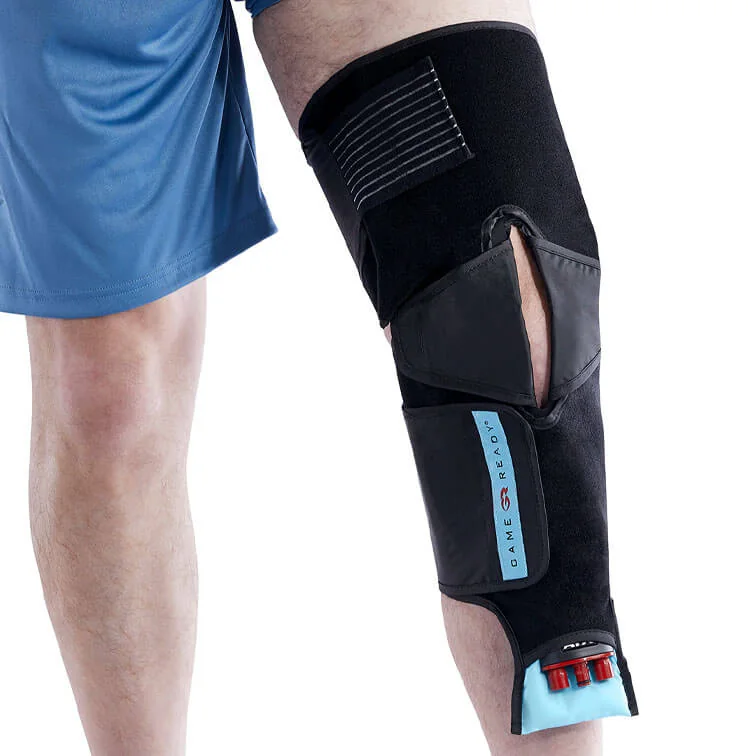
For patients after total or partial knee replacement, the machine itself is not the point. Once swelling and pain are under control, knee bending and straightening and quadriceps training can start earlier. Reducing swelling is the means, and restoring function is the goal. Nova Health offers clinic-grade cold compression machine rental with the original GameReady (GRPro 2.1). A physiotherapist delivers the machine to the home and shows how to use it correctly.
Is lasting pain normal? Most improves in the first 3 months, but about one in five has persistent pain
Feeling pain after the joint has been replaced is an expected reaction after surgery, and the main thing to watch is the trend. The ADAPT cohort study (Lenguerrand 2016) followed hip and knee replacement patients and found that most of the reduction in pain and improvement in function happened in the first 3 months after surgery, with no marked change after that. A systematic review (Beswick 2012) found that about one in five patients did not have a satisfactory long-term improvement in pain. Some mild pain in the first few months that gradually eases is therefore a normal recovery course. Long-term pain affects only a minority, but it does occur, and surgery does not guarantee a completely pain-free knee. What matters is not whether it hurts but whether the pain is gradually narrowing. If the pain stays severe or gets worse instead of better, the patient should go back for review early and should not simply endure it.
If the knee is still painful some months after the replacement, how can normal fading be told apart from pain that needs review? The stage-by-stage analysis in is it normal to still have pain months after a knee replacement covers this. Once swelling and pain have settled, the next step is rebuilding strength, because the muscles of the operated leg waste noticeably around the time of surgery. How to regain quadriceps strength after the swelling settles is another core part of recovery.
Why the skin around the wound goes numb and how it recovers
Many patients find a patch of skin beside the wound, especially on the outer side, numb, as if the skin had no feeling when touched, and they worry that the surgery has damaged a nerve. In most cases the situation is not that serious. The incision on the front of the knee cannot avoid the small branches of the infrapatellar nerve, which makes the skin around the wound less sensitive. This is a very common finding after knee replacement.
How common it is (Phruetthiphat 2020)
- Among patients without diabetes, about 68.9% have skin numbness on the front or outer side of the knee
- The proportion is higher in patients with diabetes, at about 73.2%
- In other words, about seven in ten patients meet this, and it is a common finding after surgery
How long the numbness takes to recover
- Most of the numbness fades slowly with time and does not mean permanent damage
- In patients without diabetes, recovery takes about 5.3 months on average
- In patients with diabetes, recovery is slower, at about 8.6 months on average
Local numbness is therefore no reason to stop rehabilitation exercises, and the patient should carry on with knee bending, straightening and weight-bearing training as usual. The one thing to be careful about is that the skin in the numb area is less sensitive, so a towel must be placed under the ice pack to avoid frostbite from cold the patient cannot feel. For more on whether numbness around the knee replacement scar is normal, including the expected recovery time and the few exceptions that need medical attention, see that article.
Why an artificial knee may click
An artificial joint may occasionally click, clunk or give a mild grinding feeling (patellofemoral crepitus). This often worries patients but in most cases is harmless.
The medical literature reports that this grinding noise occurs in about 0 to 18% of patients, and in nearly all of them there are no other symptoms. Conrad (2014) found that most patients with crepitus under the kneecap did not notice anything or had very mild symptoms that needed no treatment. In most cases this is just the normal mechanical sound of an artificial joint moving. What needs attention is a noise that comes together with severe pain, with the joint locking so that it cannot move, or with a feeling that the joint is loose and unstable. Those situations need a review. If the joint makes a noise but does not hurt, there is generally no need to worry.
For which clicking in an artificial knee is reassuring, which needs a review, and why these mechanical sounds occur after surgery, see the detailed explanation in is clicking in an artificial knee normal.
Warning signs of wound infection and deep vein thrombosis
Most of the swelling, pain, numbness and joint noises described above fit a normal recovery course. Two kinds of problem go in a very different direction and must be treated as red flags that need medical help quickly. Keeping the two lists below in mind means normal reactions are not mistaken for danger, and genuinely dangerous signs are not ignored.
- Redness and swelling around the wound that are not fading day by day but getting worse
- Continuing pus or fluid from the wound, especially fluid lasting more than 3 days
- The edges of the wound open up, or the pain keeps getting worse instead of easing
- General symptoms such as fever and chills
- If any one of the above occurs, contact the surgeon in charge at once
- Pain, swelling and warmth in the calf or thigh of one leg
- Redness or discolouration of the skin of the operated leg
- Sudden breathlessness, chest pain or coughing up blood, which may be a sign of pulmonary embolism
- If there are signs of a blood clot, see a doctor as soon as possible. If there is breathlessness, chest pain or coughing up blood, go to the emergency department at once
The main difference is that a wound infection is mostly concentrated at the wound (redness, swelling, pus, fluid and fever), whereas a DVT usually shows as pain, swelling and warmth in one calf, clearly different from the other leg. Hospitals generally give knee replacement patients measures to prevent blood clots after surgery, and the NICE NG89 guideline also asks staff to explain the symptoms of DVT and pulmonary embolism and how to get help. Even so, recognising the warning signs and speaking up early remains the most important safeguard for patients and families.
For reliable local information on care after surgery, patients can visit the patient education and post-operative rehabilitation pages on the Hospital Authority’s 智友站 (Smart Patient) website (www21.ha.org.hk). For community rehabilitation support, the Hong Kong Society for Rehabilitation community rehabilitation network (general enquiries 2534 3300,www.rehabsociety.org.hk) also offers follow-up services after discharge.
When to ask a physiotherapist to follow up swelling and pain
The most common difficulty for knee replacement patients after discharge is not knowing whether what they see is normal. At a home assessment, the family’s first question is often whether it is a problem that the leg is so swollen. The therapist measures the difference in circumference between the two knees on the spot and compares it with the number of days since surgery (being most swollen in the first few days is expected). The therapist also demonstrates how to raise the leg and do ankle pumps, and checks the red-flag risks of wound infection and DVT one by one. The aim is to reassure the patient and family, not to push the pace blindly. Patients also often take numbness around the wound to mean nerve damage and are afraid to move. The therapist explains that it is a common and reversible effect on a branch of the infrapatellar nerve, encourages the patient to practise bending, straightening and weight-bearing as usual, and reminds them to place a towel under the ice pack on numb skin to prevent frostbite.
The home physiotherapy that Nova Health’s registered physiotherapists provide looks at swelling, pain, numbness and joint noises together as one recovery course. The therapist checks whether the degree of swelling is reasonable by measuring circumference against the days since surgery, teaches correct icing, compression and ankle pumps at home, and helps the family tell normal reactions after surgery from the warning signs of infection or DVT. To follow the whole recovery after surgery step by step, start with the overview of physiotherapy after total knee replacement.